
Two things happened in 2026 that changed the maths for anyone financing a home in Cebu. The Pag-IBIG housing loan got cheaper and much larger, with the maximum loanable amount raised to ₱10 million and open-market rates cut. Meanwhile the central bank raised its policy rate three times, which pushes bank mortgage rates in the opposite direction.
The result is a wider gap between the two options than Cebu buyers have seen in years. This guide compares them properly: current rates on both sides, a monthly payment worked through on a real loan size, where each one wins, and the appraisal catch that surprises borrowers at the last minute.
Key takeaways
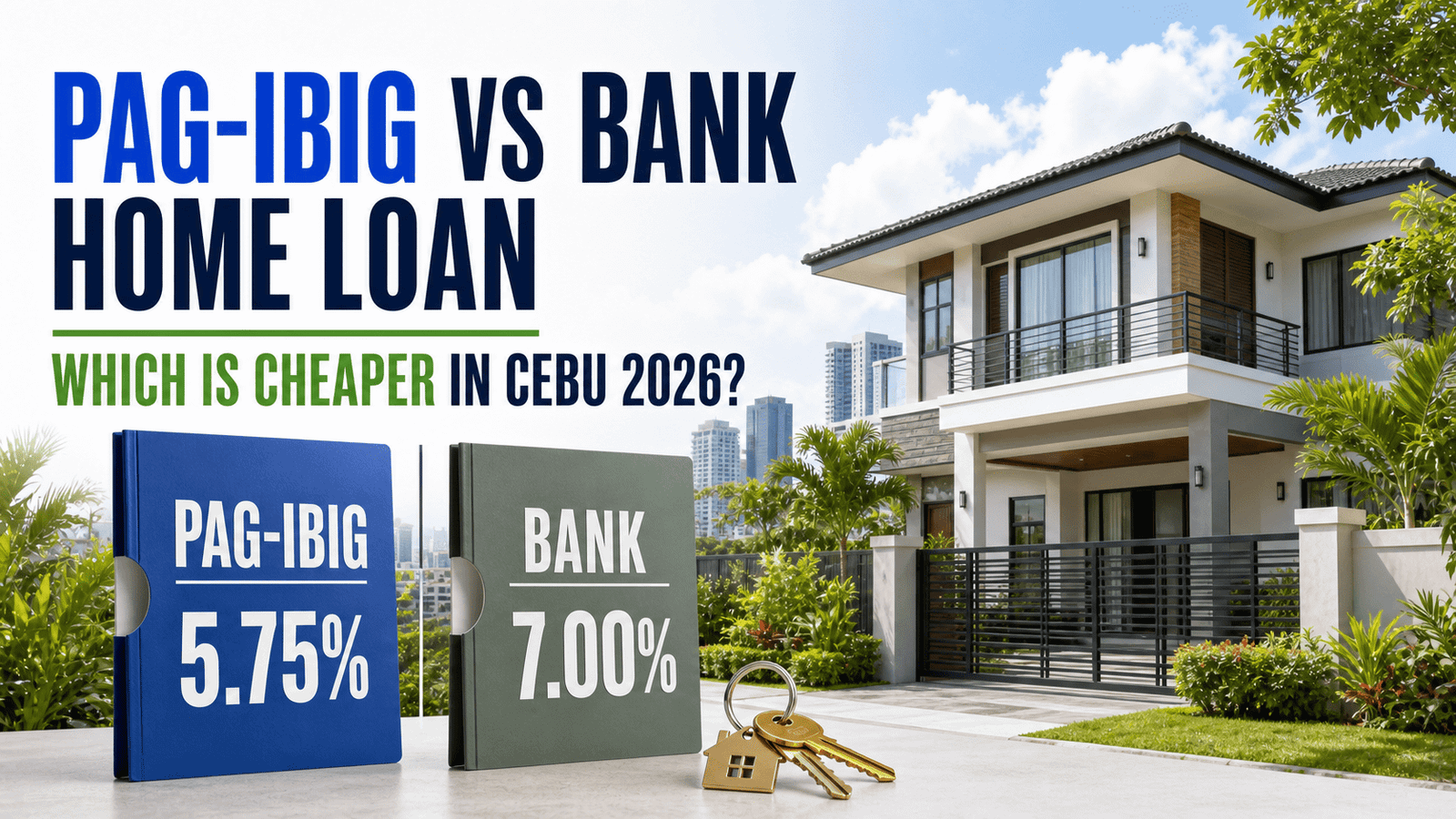
- Pag-IBIG now lends up to ₱10 million, at 5.75% for open-market housing, 4.5% low-cost and 3% socialised.
- Bank rates were quoted around 6.25% to 8.5% in April 2026, and the central bank has raised rates twice since.
- On a ₱4 million loan over 20 years, the rate gap is worth roughly ₱700,000 in total payments.
- Pag-IBIG offers up to 30 years. Most banks stop at 20, which changes the monthly figure considerably.
- Banks usually win on speed and flexibility, which matters when a seller wants to close quickly.
- Your loan is capped by the appraised value, not the price you agreed. This is where deals fall over.
What Changed in 2026
The two sides of this comparison moved in opposite directions this year, which is unusual and worth understanding.
On the government side, the fund raised its ceiling and cut its pricing. The maximum Pag-IBIG housing loan went up to ₱10 million, and rates were reduced to 3% for socialised housing, 4.5% for low-cost housing and 5.75% for open-market housing, as the Philippine Information Agency reported. For a Cebu buyer that ceiling matters: ₱10 million now covers most mid-market houses and a great many condominium units in the city.
On the commercial side, monetary policy tightened. The central bank raised its policy rate to 5.00% in late August 2026, the third increase of the year, as BusinessWorld reported. Bank mortgage pricing follows the policy rate with a lag, so quotes issued now are higher than those published earlier in the year.
Put simply, the gap between a Pag-IBIG housing loan and a bank mortgage has widened, and it has widened in the fund’s favour.
How the Pag-IBIG Housing Loan Works
A Pag-IBIG housing loan is funded by the government savings scheme that Filipino employees contribute to monthly. Those contributions buy you access to a housing loan on terms no commercial lender matches.
| Feature | Detail |
|---|---|
| Maximum loan | ₱10 million |
| Open-market rate | 5.75% |
| Low-cost housing rate | 4.5% |
| Socialised housing rate | 3% |
| Maximum term | Up to 30 years |
| Who can borrow | Members with the required monthly savings, capacity to pay and a satisfactory credit record |
| Overseas Filipinos | Membership is mandatory and members are eligible to borrow |
Two features deserve emphasis. The 30-year term is longer than almost any Philippine bank will offer, which lowers the monthly payment substantially. And the loan can be used to buy a house and lot, a condominium unit, a residential lot, or to construct or improve a home, which is broader than many buyers assume.
The trade-off is process. A Pag-IBIG housing loan generally takes longer to approve than a bank loan, the documentation is exacting, and the appraisal is conservative. If your seller is in a hurry, that friction is real.
How Bank Home Loans Work
Where a Pag-IBIG housing loan has one headline rate, Philippine banks price mortgages by fixing period. You choose how long your rate is locked, and the longer the lock, the higher the rate. When the fixing period ends, the loan reprices at whatever the market is doing then.
The table below shows rates compiled in early April 2026. Treat it as a structural guide rather than a live quote, because the central bank has raised its policy rate twice since that date.
Swipe the table sideways to see every column.
| Bank | 1-year fixing | 3-year fixing | 5-year fixing |
|---|---|---|---|
| Security Bank | 6.25 to 7.00% | 6.75 to 7.50% | 7.25 to 8.00% |
| BPI | 6.50 to 7.00% | 7.00 to 7.50% | 7.50 to 8.00% |
| Landbank | 6.50 to 7.00% | – | 7.50 to 8.00% |
| BDO | 6.50 to 7.25% | 7.00 to 7.75% | 7.50 to 8.25% |
| RCBC | 6.50 to 7.25% | 7.00 to 7.75% | 7.50 to 8.25% |
| Metrobank | 6.75 to 7.50% | 7.25 to 8.00% | 7.75 to 8.50% |
| UnionBank | 6.75 to 7.50% | 7.25 to 8.00% | 7.75 to 8.50% |
| China Bank | 7.00 to 7.75% | 7.50 to 8.25% | 8.00 to 8.75% |
Typical bank terms elsewhere in the package: loan-to-value of 70% to 80%, occasionally 90% for a strong borrower with a strong property; maximum term commonly 20 years; and a borrower age limit at maturity, usually 65 or 70.
Understand repricing before you sign. A one-year fixing looks cheap and is genuinely risky in a rising-rate cycle. If you take a one-year fix at 6.5% and rates keep climbing, your payment resets upward twelve months later. Stress-test your budget at two percentage points above the offered rate. If it does not survive that, take the longer fix.
Head to Head
Swipe the table sideways to see every column.
| Factor | Pag-IBIG | Bank |
|---|---|---|
| Interest rate | Lower, from 5.75% | Higher, and rising |
| Maximum loan | ₱10 million | Effectively uncapped for strong borrowers |
| Maximum term | Up to 30 years | Commonly 20 years |
| Speed of approval | Slower | Faster |
| Appraisal | Conservative | Usually more generous |
| Flexibility on property type | Standard residential | Broader, including unusual properties |
| Rate certainty | Repricing at set intervals | Repricing at set intervals |
| Best for | Owner-occupiers maximising affordability | Buyers needing speed, size or flexibility |
The Monthly Payment Compared
Comparing a Pag-IBIG housing loan with a bank in the abstract means little. Here is a ₱4,000,000 loan, which is a realistic figure for a Cebu townhouse or a two-bedroom condominium after a 20% down payment.
Swipe the table sideways to see every column.
| Option | Rate | Term | Monthly | Total paid |
|---|---|---|---|---|
| Pag-IBIG | 5.75% | 20 years | ₱28,084 | ₱6,740,160 |
| Bank | 7.00% | 20 years | ₱31,010 | ₱7,442,400 |
| Pag-IBIG | 5.75% | 30 years | ₱23,343 | ₱8,403,480 |
Two lessons sit in that table, and they pull against each other.
First, on identical 20-year terms the rate difference costs about ₱2,926 a month, or ₱702,240 over the life of the loan. That is a serious sum for a difference of 1.25 percentage points, and it is why the rate deserves more attention than most buyers give it.
Second, stretching to 30 years cuts the monthly payment by nearly ₱4,750, which is the difference between qualifying and not qualifying for many households. But it adds more than ₱1.6 million in total interest against the 20-year version. A longer term buys affordability today and pays for it later. Choose deliberately.
The Appraisal Catch That Breaks Deals
This applies to a Pag-IBIG housing loan and a bank mortgage alike, and it is where Cebu purchases most often come apart, and almost nobody explains it before it happens.
Your loan is not a percentage of the price you agreed. It is a percentage of the lower of the agreed price and the lender’s own appraised value, and it is capped again by your assessed capacity to pay.
Work an example. You agree ₱5,000,000 on a house and expect to borrow 80%, so ₱4,000,000, leaving ₱1,000,000 to find. The lender appraises the property at ₱4,400,000. Eighty per cent of that is ₱3,520,000. Your cash requirement has just risen from ₱1,000,000 to ₱1,480,000, and you have days rather than weeks to produce it.
Three defences. Ask early what the property is likely to appraise at, because an experienced local broker will have a view. Build a financing contingency into your offer so you can withdraw if the valuation falls short. And keep a reserve beyond your down payment, because you also owe roughly 8% to 10% in transfer taxes and fees, which our breakdown of homebuying costs in Cebu sets out line by line.
How Much House Does Your Income Buy?
Lenders assess capacity to pay before anything else. As a rule of thumb, total monthly debt service is expected to stay within roughly 30% of gross household income, though the precise ratio varies by lender and by how much other debt you carry.
The table below applies that rule to a Pag-IBIG housing loan at 5.75% over 30 years, then works back to a purchase price assuming an 80% loan.
Swipe the table sideways to see every column.
| Gross monthly income | Payment at 30% | Loan supported | Purchase price at 80% LTV |
|---|---|---|---|
| ₱30,000 | ₱9,000 | ₱1.54M | ₱1.93M |
| ₱50,000 | ₱15,000 | ₱2.57M | ₱3.21M |
| ₱80,000 | ₱24,000 | ₱4.11M | ₱5.14M |
| ₱120,000 | ₱36,000 | ₱6.17M | ₱7.71M |
| ₱200,000 | ₱60,000 | ₱10M, at the cap | ₱12.5M |
Two observations for Cebu buyers. A household on ₱80,000 a month can realistically look at properties around ₱5 million, which in the current market covers a great deal of the mid-market condominium stock and a reasonable range of townhouses in Talamban, Mandaue and the northern corridor. And the ₱10 million ceiling only becomes binding at incomes above roughly ₱195,000 a month, so for most buyers it is not a constraint at all.
Note also that a shorter 20-year term reduces what you can borrow at any given income, because the monthly payment on the same loan is higher. If affordability is tight, the 30-year term is what makes the purchase possible, with the total interest cost noted above as the price of that.
The subsidised tiers are worth checking
The 3% socialised and 4.5% low-cost rates are not marketing. They apply to housing that falls within the relevant price bands, and the difference against the open-market rate is large. On a ₱2 million loan over 30 years, 3% costs roughly ₱8,430 a month against about ₱11,670 at 5.75%.
Cebu has a real supply of housing in the economic band, which industry analysis puts broadly between ₱580,000 and ₱2.5 million. If you are buying at that level, ask specifically which rate tier the property qualifies for before you accept an open-market quote. It is the single easiest saving available to a first-time buyer, and it is routinely missed.
Coverage of the expanded programme and who qualifies is set out in Cebu Daily News, and the fund publishes current terms on its official website.
Overseas Filipinos and Foreign Buyers
For overseas Filipinos the Pag-IBIG housing loan is usually the strongest option available. Membership is mandatory for OFWs, and members are eligible to borrow on the same terms as domestic members. The practical hurdles are documentary rather than financial: proof of income from an overseas employer, and a Special Power of Attorney so someone can sign on your behalf in the Philippines. Prepare the power of attorney early, consularised or apostilled, because it is the most common cause of delay. Our property investment guide for overseas Filipinos covers the rest of the process.
Foreign nationals cannot access Pag-IBIG, so a bank is the only route. Several major Philippine banks do lend to foreigners, typically requiring 20% to 30% down, a passport, valid visa documentation, an Alien Certificate of Registration and several months of bank statements. Permanent residency, a retirement visa or a long-term employment visa materially improves the terms, and some lenders still want a Filipino co-borrower. What a foreigner can actually buy is a separate question, covered in our guide to foreigners buying property in Cebu.
Preparing Your Application
Whether you go for a Pag-IBIG housing loan or a bank, the same preparation shortens the process and improves the offer you get.
- Get pre-qualified before you shop. Knowing your ceiling stops you falling for something you cannot finance.
- Clean up your credit record. Settle small delinquencies, close unused cards, and avoid new debt in the six months before applying.
- Document your income properly. Payslips, tax returns and bank statements should agree with each other. Self-employed applicants need audited statements.
- Check the property is financeable. A clean title, no adverse annotations and, for pre-selling, a valid licence to sell. Our guide to the land title transfer process in Cebu covers what lenders look for.
- Apply to more than one lender. Rates within the published ranges are negotiable, and a competing offer is the only leverage that reliably works.
- Budget for the extras. Mortgage redemption insurance and fire insurance are usually mandatory, plus appraisal and processing fees.
Pag-IBIG Housing Loan FAQ
Is a Pag-IBIG housing loan always cheaper than a bank?
On rate, currently yes, and by a meaningful margin. On total cost it depends on the term you choose, because a 30-year loan at a lower rate can still cost more overall than a 20-year loan at a higher one. Compare total payments, not just the monthly figure.
Can I use Pag-IBIG to buy a condominium in Cebu?
Yes. The loan covers a house and lot, a condominium unit, a residential lot, and construction or home improvement. The unit must have a clean title and meet the fund’s appraisal requirements.
Can I refinance a bank loan into Pag-IBIG later?
Loan takeout between lenders is possible in the Philippines and Pag-IBIG has historically offered it. Check current eligibility directly, and factor in the costs of the switch, which can absorb a year or more of the savings.
How much deposit do I need in Cebu?
With a Pag-IBIG housing loan or a bank mortgage, plan for 20% to 30% of the price as down payment, plus 8% to 10% for taxes and fees. On a ₱5 million purchase that is roughly ₱1.4 million to ₱2 million in cash. Buyers working to a tighter budget should look at our roundup of affordable Cebu properties under ₱5 million.
Will rates keep rising?
Nobody knows. What is knowable is that the central bank raised three times in 2026 and cited continuing inflation risks. Budget as though rates rise further, and treat any decline as a bonus rather than a plan.
Does the loan affect my rental yield if I let the property?
Yes, substantially, and mortgage interest is deductible if you use graduated income tax rates rather than the flat option. Our guide to Cebu rental yields works through the full cost stack.
Working out what you can afford?
Tell us your budget and we will show you Cebu properties that fit it, and flag anything likely to appraise below the asking price.
Keep reading
- Cebu Real Estate Market 2026
- Condo Association Dues in Cebu
- Real Property Tax in Cebu
- Common Mistakes Property Buyers Make in Cebu
Rates and terms current to August 2026. Bank rates were compiled in April 2026 and predate two central bank increases, so live quotes will differ. Amortisation figures are illustrative and exclude insurance and fees. This is general information, not financial advice; confirm terms directly with Pag-IBIG or your lender.