

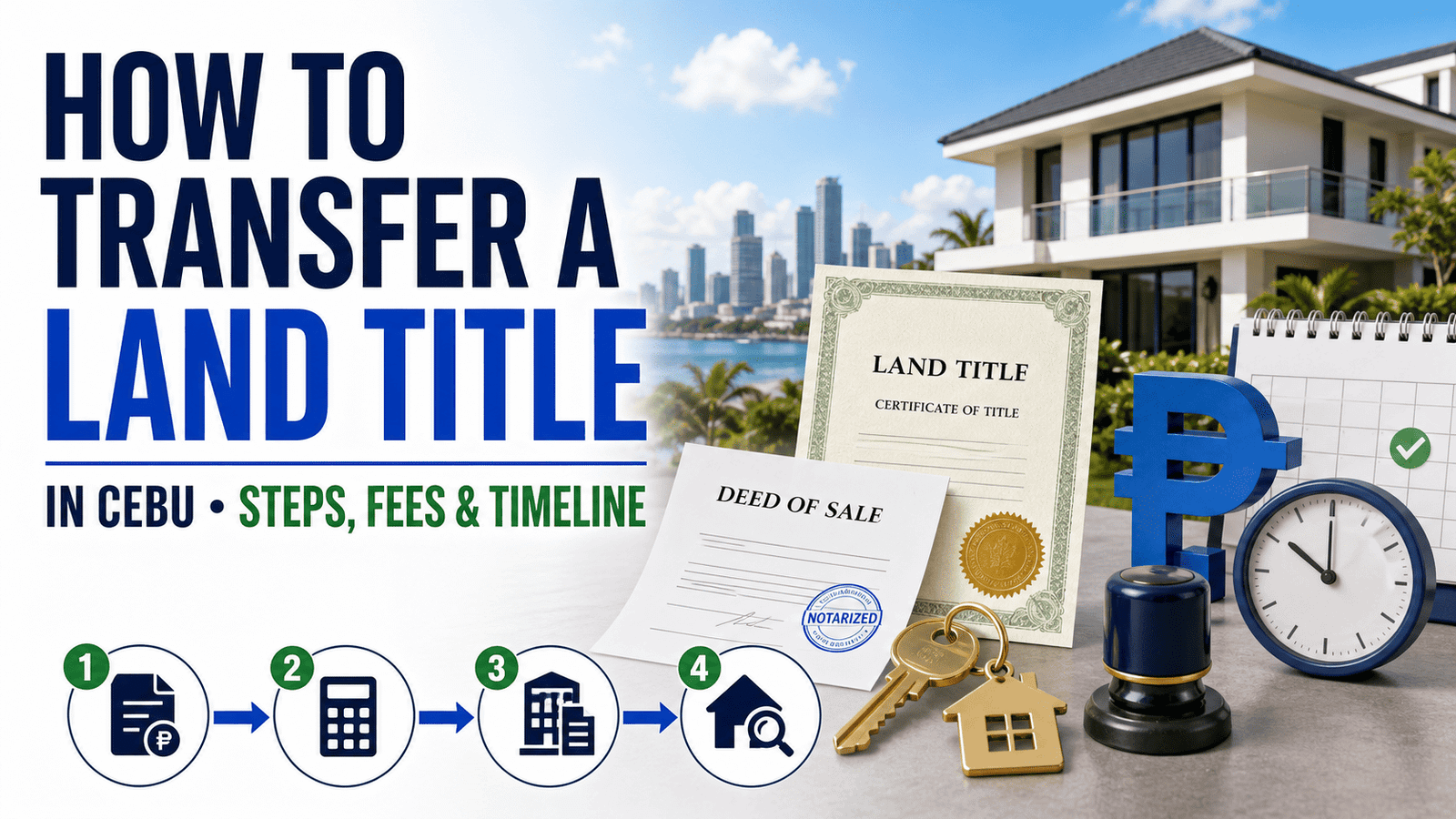
A land title transfer in Cebu is not one transaction at one counter. It is a sequence that runs through four separate offices, in a fixed order, with deadlines attached to three of them. Miss a deadline and you pay penalties. Skip a step and the Registry of Deeds simply will not issue the new title.
This guide walks a land title transfer in Cebu end to end: the documents you need before you start, what each office does, what each stage costs, how long it realistically takes, and the situations that stall a transfer for months. It applies to a normal sale between private parties. Buying from a developer follows a different route, covered near the end.
Key takeaways
- Four offices, in order: BIR, then the city or municipal treasurer, then the Registry of Deeds, then the assessor.
- Three hard deadlines: documentary stamp tax within 5 days after the month of notarisation, capital gains tax within 30 days, local transfer tax within 60 days.
- Nothing moves without the electronic Certificate Authorizing Registration from the BIR.
- Total transfer costs typically run 8% to 10% of the price.
- Realistic end-to-end timing is two to four months, and longer if the registered owner has died or taxes are unpaid.
- Order the certified true copy of the title yourself. It costs under ₱700 and it is the cheapest insurance in the whole transaction.
The Four Offices in a Land Title Transfer in Cebu
A land title transfer in Cebu touches four offices, and understanding who does what removes most of the confusion. Each office has one job, and each one needs proof that the previous office is satisfied.
Swipe the table sideways to see every column.
| Office | Its job | What it issues |
|---|---|---|
| Bureau of Internal Revenue | Collects capital gains tax and documentary stamp tax | Electronic Certificate Authorizing Registration |
| City or municipal treasurer | Collects the local transfer tax | Transfer tax receipt and clearance |
| Registry of Deeds | Cancels the old title, issues the new one | New TCT or CCT in the buyer’s name |
| City or municipal assessor | Updates the assessment record | New tax declaration in the buyer’s name |
A common misconception is that the transaction ends when the new title is released. It does not. Until the assessor issues a new tax declaration in your name, the annual real property tax bill still goes to the seller, and that causes problems later.
Documents to Gather Before You Start
Every land title transfer in Cebu starts with paperwork. Assemble everything on this list before you go anywhere near a government counter. An incomplete file is the single biggest cause of delay, because official processing clocks only start once documents are complete.
- Notarised Deed of Absolute Sale, in several original copies
- Owner’s duplicate certificate of title, the seller’s original
- Certified true copy of the title from the Registry of Deeds, recently issued
- Latest tax declaration for the land, and separately for the building if there is one
- Real property tax clearance showing nothing is owed
- Certificate of No Improvement from the assessor, for bare land
- Valid IDs and Tax Identification Numbers for both parties
- Marriage certificate, and written spousal consent where the seller is married
- Special Power of Attorney, consularised if signed abroad, where anyone signs by proxy
- Approved subdivision plan and technical description, if only part of a titled parcel is being sold
If the registered owner has died, add the estate documents. That path is longer and is covered under red flags below.
The Step-by-Step Process
Step 1. Verify the title before you pay anything
Begin every land title transfer in Cebu here. Go to the Registry of Deeds and order a certified true copy of the title yourself. Do not accept the seller’s photocopy, and do not send the seller to get it. This is the step that catches forged titles, undisclosed mortgages and annotations the seller forgot to mention.
The Land Registration Authority publishes the fees. A certified true copy costs about ₱197 for the first two pages at the Registry of Deeds counter, or about ₱645 through the online portal, with roughly ₱38 per additional page. Release is one working day for an electronic title and about three for a manually converted one. Titles can also be requested from any registry under the anywhere-to-anywhere service.
Read the back of the title as carefully as the front. Encumbrances, mortgages, adverse claims and notices of lis pendens are annotated there. Our guide on judging whether a property is overpriced covers the valuation side of the same homework.
Step 2. Sign and notarise the deed of sale
The deed must be notarised to be registrable. Notarial fees are not fixed by any national schedule; the notarial rules only prohibit excessive or unconscionable charges, and local bar chapters set their own guidance. In practice expect roughly 1% to 2% of the price or fair market value, whichever is higher, and negotiate it like any other fee.
Note the notarisation date. Two tax deadlines run from it.
Step 3. Pay the BIR taxes
This is the stage that decides how quickly a land title transfer in Cebu completes. Two taxes fall due, and they are filed at the revenue district office with jurisdiction over where the property sits, not where either party lives.
- Capital gains tax, 6%, on the highest of the selling price, the BIR zonal value or the assessor’s fair market value. Filed on BIR Form 1706 within 30 days of the sale, per the BIR’s own filing guidelines. By custom the seller pays, but the form is filed jointly.
- Documentary stamp tax, 1.5%, calculated as ₱15 for every ₱1,000 or fraction thereof, on the same base. Filed on Form 2000-OT within five days after the close of the month in which the deed was notarised. Who pays is negotiable and it is frequently the buyer.
Both deadlines are short and both attract surcharges and interest. Notarise on the 28th of a month and your stamp tax is due within days.
Step 4. Get the electronic CAR
The electronic Certificate Authorizing Registration is the BIR’s confirmation that the taxes are settled. Without it no land title transfer in Cebu can proceed. The BIR’s current service standard sets a computation sheet at three working days for a simple case, and the eCAR itself at not more than seven working days from receipt of complete documents.
Read that standard carefully. Seven working days is measured from complete documents. In practice most delays happen before the clock starts, while one more certificate is chased. Budget weeks, not days, and keep a checklist.
Step 5. Pay the local transfer tax
Take the eCAR and the deed to the treasurer of the city or municipality where the property is located. Under the Local Government Code, a province may levy up to 0.5% of the consideration or fair market value, and a city may exceed that ceiling by up to half again, which is how city rates reach 0.75%. Payment is due within 60 days of the deed.
Rates vary between Cebu City, Mandaue, Lapu-Lapu and the provincial municipalities, so confirm the current figure with the treasurer’s office rather than assuming. You will also need a real property tax clearance at this stage, which means any arrears must be settled first.
Step 6. Register at the Registry of Deeds
Submit the deed, the owner’s duplicate title, the eCAR, the transfer tax receipt and the tax clearance. Pay the registration fee, which follows a bracketed schedule set by the Land Registration Authority and rises with the value of the property, plus an information technology fee.
The registry cancels the seller’s title and issues a new one in your name. Under Presidential Decree 1529, land carries a Transfer Certificate of Title and a condominium unit carries a Condominium Certificate of Title. Check every detail on the new title against the old one before you leave, particularly the technical description and the area.
Step 7. Update the tax declaration
Take the new title to the assessor and request a new tax declaration in your name. Only then does the annual real property tax bill follow you rather than the previous owner. This last step is skipped surprisingly often, and it causes trouble at the next sale.
What a Land Title Transfer in Cebu Costs
Here is a worked example on a ₱5,000,000 sale, assuming the selling price is the highest of the three valuation bases and the parties split costs by the usual custom.
Swipe the table sideways to see every column.
| Item | Rate | On ₱5,000,000 | Usually paid by |
|---|---|---|---|
| Capital gains tax | 6% | ₱300,000 | Seller |
| Documentary stamp tax | 1.5% | ₱75,000 | Negotiable |
| Local transfer tax | Up to 0.75% in a city | Up to ₱37,500 | Buyer |
| Registration fee | LRA bracketed schedule | Roughly ₱25,000 | Buyer |
| Notarial fee | Commonly 1% to 2% | ₱50,000 to ₱100,000 | Negotiable |
| Certified copies and incidentals | Fixed fees | ₱2,000 to ₱5,000 | Buyer |
Two things skew this in practice. First, if the BIR zonal value or the assessor’s valuation exceeds your selling price, the taxes are computed on the higher figure, not on what you actually paid. Ask for the zonal value before you agree a price. Second, a newly built residential dwelling above the VAT threshold attracts 12% VAT on top of everything here, which is why a developer purchase looks so different.
Our full breakdown of homebuying costs in Cebu works through the budgeting side, including the costs that fall outside the transfer itself.
How Long It Really Takes
| Stage | Realistic duration |
|---|---|
| Title verification and due diligence | 1 to 2 weeks |
| Deed drafting and notarisation | A few days |
| Assembling the complete BIR file | 2 to 4 weeks, and this is where most delay sits |
| BIR processing to eCAR | 1 to 3 weeks once the file is complete |
| Transfer tax at the treasurer | 1 to 3 days |
| Registry of Deeds, new title issued | 2 to 4 weeks |
| New tax declaration at the assessor | 1 to 2 weeks |
Two to four months end to end is a fair expectation for a land title transfer in Cebu for a clean transaction. Anyone promising two weeks is either doing something unusual or is not counting the parts they have not started yet.
Where Transfers Go Wrong
These are the situations that turn a three-month land title transfer in Cebu into a year-long one. Every item here is worth checking before you release funds.
- The registered owner has died. You cannot buy directly from heirs without first settling the estate. That means an extrajudicial settlement, publication, and estate tax at 6% of the net estate. Add months, and often a lawyer.
- Unpaid real property tax. No clearance, no transfer. Establish the arrears position early and agree in writing who settles it.
- No spousal consent. Where the property is community or conjugal, a sale without the other spouse’s written consent is void, not merely voidable.
- The owner’s duplicate title is missing. Without it the registry cannot issue a new certificate. Reconstitution is a court process.
- An adverse claim or lis pendens is annotated. An adverse claim signals a competing ownership assertion. A notice of lis pendens means the property is in litigation. Neither is a detail to sort out later.
- The parcel is part of a mother title. If your lot has never been segregated, a survey, approval and separate title must come first.
- Tax declaration only, no title. This is not a transfer problem; it is an ownership problem. A tax declaration records who pays tax. It proves nothing about who owns.
- The technical description does not match the ground. Have a licensed geodetic engineer relocate the boundaries where the area is large or the boundaries are unclear.
Our roundup of the most common mistakes property buyers make in Cebu covers several of these from the buyer’s side.
Buying From a Developer Is a Different Route
A land title transfer in Cebu works differently when the seller is a developer habitually engaged in real estate. capital gains tax does not apply. Instead a creditable withholding tax is withheld at graduated rates, commonly 1.5%, 3% or 5% depending on the price band, and the sale attracts VAT where the dwelling exceeds the threshold.
Three protections matter here, all from Presidential Decree 957 and the Maceda Law.
- The project must hold a Certificate of Registration and a Licence to Sell from DHSUD. Selling without one is unlawful. Ask to see both.
- The developer must deliver the title on full payment. Long delays after final payment are a breach, not a formality.
- Under the Maceda Law, a buyer who has paid at least two years of instalments gets one month of grace for every year paid, and a cash surrender value of 50% of total payments, rising after five years. Below two years of payments there is a grace period of at least 60 days but no cash surrender value. That two-year cliff is the fact most articles get wrong.
Land Title Transfer in Cebu: FAQ
Who pays the capital gains tax, the buyer or the seller?
In a land title transfer in Cebu the seller customarily pays capital gains tax and the buyer pays the transfer tax and registration fees. Documentary stamp tax is genuinely negotiable. None of this is fixed by law, so write the split into the deed of sale rather than relying on what is usual.
Can I transfer a title without a lawyer?
Legally yes, for a simple sale between living parties with a clean title. In practice a lawyer or an experienced broker earns their fee on the document assembly alone. Use one whenever an estate, a mortgage, a corporation or an unsegregated parcel is involved.
What happens if I miss the 30-day capital gains deadline?
Surcharges and interest accrue, and they compound while the file sits. Late filing does not void the sale, but it makes it more expensive and it delays the eCAR, which delays everything downstream.
The seller wants payment before the title transfer. Is that normal?
Full payment on signing is common in the Philippines, because the seller needs funds to pay capital gains tax. Protect yourself by holding a portion in escrow or with a mutually trusted third party until the eCAR is released, and by verifying the title first.
Is the process different for a condominium?
The steps are the same, but the title is a Condominium Certificate of Title rather than a Transfer Certificate of Title, and you will also need a certificate of full payment of association dues from the condominium corporation before the transfer completes.
Can an overseas seller or buyer sign remotely?
Yes, through a Special Power of Attorney executed abroad and authenticated at a Philippine embassy or consulate, or apostilled. Prepare this early; it is a frequent source of delay. Overseas Filipinos will find more context in our property investment guide for overseas Filipinos.
Need a hand with a Cebu transfer?
We check titles, flag annotations and walk buyers through the paperwork from due diligence to the new tax declaration.
Keep reading
- Can Foreigners Buy Property in Cebu?
- Cebu Real Estate Market 2026
- Complete Cebu Real Estate Guide for Buyers and Investors
- Mactan Real Estate Guide 2026
General information current to August 2026, drawn from the National Internal Revenue Code, PD 1529, PD 957, RA 6552, the Local Government Code and published BIR and Land Registration Authority guidance. It is not legal or tax advice, and local rates and procedures change. Confirm current figures with the relevant office and take professional advice on your own transaction.